Success message
Error message

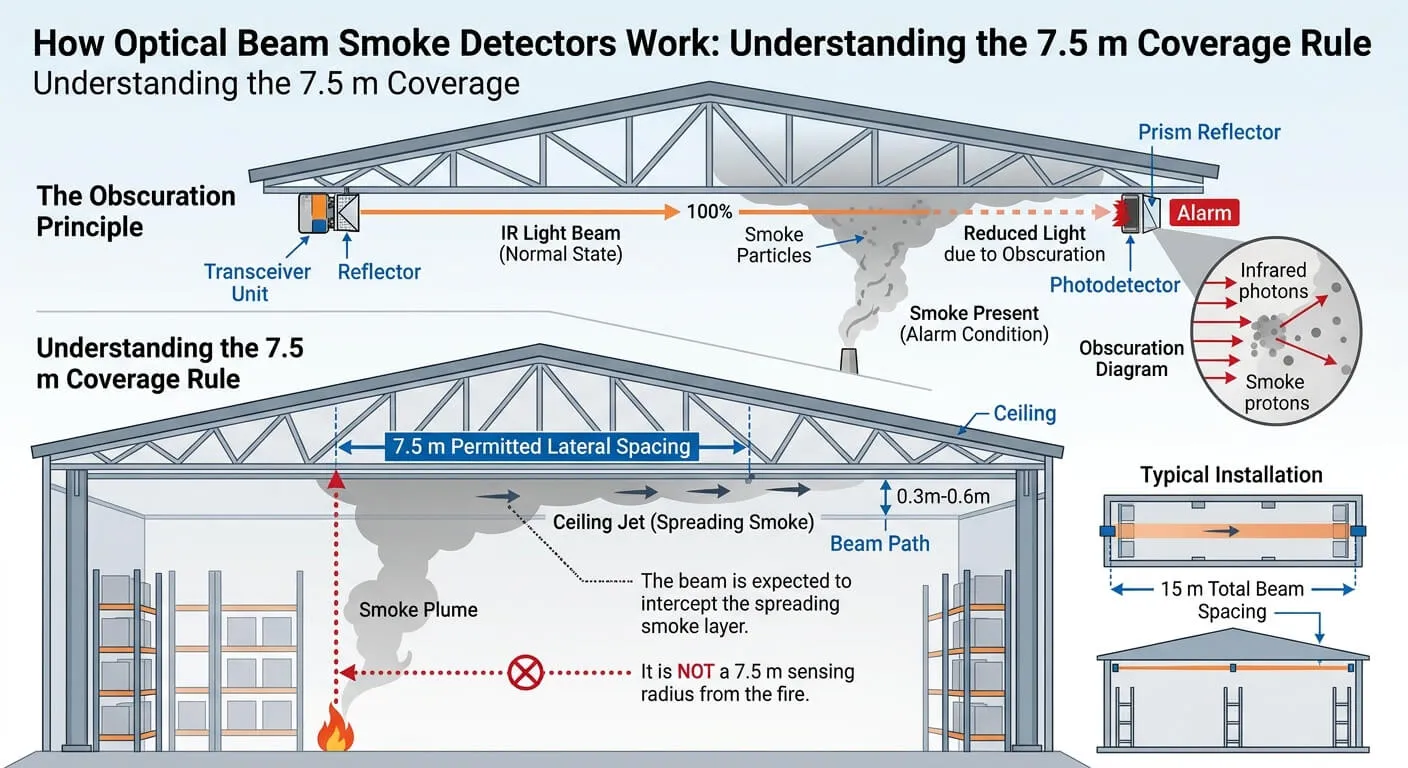
Optical beam smoke detectors are widely specified for warehouses, factories, shopping centres, sports halls and atriums. In spaces with high ceilings, a single beam can protect an area that would otherwise need many point-type detectors, some of them difficult to reach for maintenance.
One point regularly causes confusion, though: if smoke has to enter the beam to trigger an alarm, how can a beam detector be permitted to cover up to 7.5 m on either side of it? This article explains how beam detectors work and what the 7.5 m figure actually means.
A projected beam smoke detector sends a beam of infrared light across the protected space. Most systems use one of two arrangements:
Separate transmitter and receiver, mounted opposite each other.
A combined transmitter and receiver unit with a reflector, where the beam is returned to the same housing by a prism.
The receiver continuously measures the strength of the incoming light. When smoke enters the beam path, its particles absorb and scatter some of the light, so less reaches the receiver. If the reduction passes the configured alarm threshold, and in many products stays there for a short set period, the detector signals a fire condition.
This is known as the obscuration principle. The detector does not identify individual particles. It responds to the loss of light along the beam. By contrast, a point-type optical detector works on light scattering: smoke entering its small chamber scatters light onto a photosensor.
The 7.5 m figure is a permitted lateral spacing. It is the maximum horizontal distance between the beam axis and any point in the area it is allowed to protect, subject to the applicable standard (in the UK, BS 5839-1) and the manufacturer's instructions. In practice, one beam can be treated as protecting a strip up to 15 m wide along its length.
It does not mean the detector can sense smoke 7.5 m away without that smoke reaching the beam. The figure rests on how smoke behaves in a fire. Hot smoke rises in a plume, reaches the ceiling and spreads outwards beneath it. A correctly positioned beam is expected to intercept that spreading smoke, and the detector responds once enough of it crosses the optical path.
Yes. A conventional beam detector responds only when smoke enters its optical path. If smoke never reaches the beam, the detector may not respond, even if the fire is within the nominal coverage area. That is why position, height and building geometry matter so much.
Manufacturers typically specify that the beam is mounted 0.3 m to 0.6 m below, and parallel to, the ceiling. Under some conditions a layer of warm, static air can form beneath the ceiling and stop smoke from rising all the way up. Positioning the beam slightly below the ceiling brings it into the smoke layer rather than leaving it above it.
The 7.5 m figure is not a universal rule. Before specifying a beam installation, consider:
Ceiling shape. Some manufacturers allow the lateral distance to be increased for pitched roofs, for example by 1% per degree of pitch, but only for a beam positioned in the apex.
Obstructions. The beam path must be kept clear, and guidance typically calls for the beam to be kept away from structural protrusions.
Mounting height and detector model. Limits vary between products.
Air movement and smoke behaviour. Ventilation and stratification can affect how smoke reaches the beam.
Environmental conditions. Direct sunlight, for instance in glazed atriums, needs careful consideration.
Always check the current edition of the relevant standard and the manufacturer's installation guidance for the specific product.
A beam detector monitors a path of light, and smoke must enter that path to trigger an alarm. The 7.5 m distance describes the area the beam is permitted to protect, based on how smoke rises and spreads. It is not a detection radius. Correct positioning, height and design are what make a beam installation reliable.
Want to understand BS 5839-1:2025 in depth? Our EAL Level 3 Award in Requirements for BS 5839-1:2025 is a BAFE SP203-1 approved qualification. Find out more