Success message
Error message

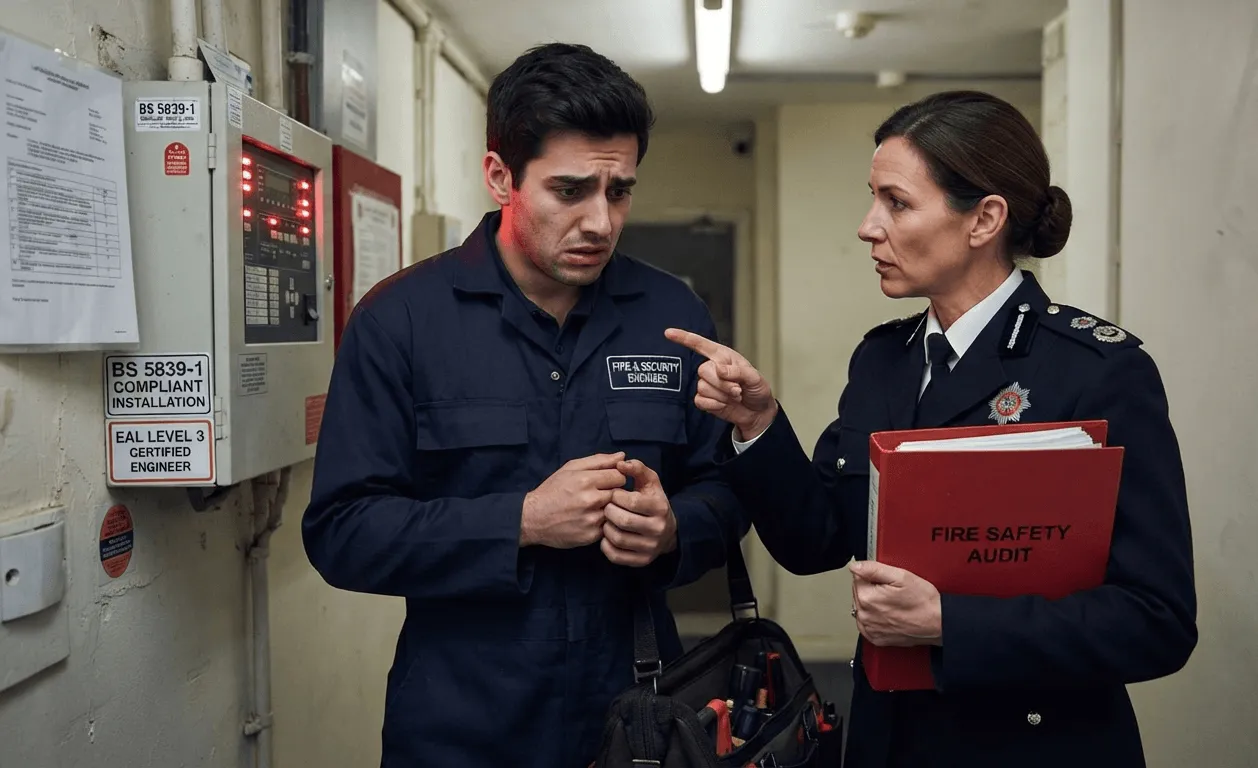
In May 2025, Fylde Fire Systems Limited was sentenced at Blackburn Magistrates' Court after pleading guilty to three offences under the Regulatory Reform (Fire Safety) Order 2005. The case, brought by Lancashire Fire and Rescue Service, followed an inspection of Morvern Care Centre in Thornton-Cleveleys in December 2020, where fire safety breaches were serious enough to trigger a Prohibition Notice and the relocation of 45 elderly and vulnerable residents over the following two weeks.
The company was found to have failed to ensure the premises had appropriate fire detectors and alarms, failed to maintain the equipment provided to an efficient standard, and failed to cooperate with other responsible persons on the premises. It was fined £30,000 plus a £2,000 victim surcharge, and ordered to pay £18,725 in costs to Lancashire Fire and Rescue Service. Ian Armistead, the service's Protection Department Group Manager, said the outcome sent a message that fire safety professionals must be competent to perform any type of fire safety duties, particularly in complex, high-risk premises where occupants depend on that competence to stay safe.
It's a stark reminder that this isn't an abstract compliance topic. It's a specialist fire alarm company, working in a care home, whose failures were serious enough to empty the building. That combination — competence failure plus a vulnerable occupancy — is precisely the scenario the industry's tightening standards are now designed to prevent.
This matters for two audiences at once: the building owners and responsible persons who commission fire alarm work and carry legal liability for it, and the installers and engineers whose livelihoods depend on being able to prove, not just claim, that they are competent.
Under the Fire Safety Order, as amended by the Fire Safety Act 2021, the “responsible person” for a building must ensure that fire safety equipment is maintained by a “competent person.” For a long time, the industry had no consistent, verifiable way to define what that meant in practice for an individual engineer. A company could hold BAFE or FIA membership at organisational level while the engineer standing at the panel had no formally assessed qualification at all.
That ambiguity created room for contractors to operate on reputation and price alone, with no third-party check on whether the person designing, installing, or commissioning a system actually understood BS 5839-1, cause-and-effect programming, or the difference between an L1 and an L3 category system. The Fylde Fire Systems case shows what that gap can look like in practice — and why a Prohibition Notice, rather than a quiet word, was the fire service's response.
The response from the industry's own certification bodies has been to close the loophole from the inside, ahead of tighter statutory scrutiny.
BAFE's SP203-1 scheme (the recognised third-party certification for non-domestic fire detection and alarm systems) now requires named engineers, not just certificated companies, to hold a nationally recognised regulated qualification at Ofqual Level 3 or SCQF equivalent, covering design, installation, commissioning, or maintenance as applicable to their role.
The EAL Level 3 Award in the Requirements of Fire Detection and Fire Alarm Systems for Buildings BS 5839-1:2025meets this requirement.
UKAS accreditation — the “crown and tick” — sits above both BAFE and the FIA in the assurance chain, so a responsible person checking a contractor's credentials now has a genuine hierarchy to verify, rather than a single logo to take on trust.
The effect is that “we're a member of a trade body” and “we're third-party certificated to a UKAS-accredited scheme” are no longer the same claim. The industry has, in effect, built its own competence register faster than it might otherwise have been required to.
The Building Safety Act 2022 reinforces this from the regulatory side. For higher-risk buildings, the Gateway process and the golden thread of information require a documented, traceable record of who did what, to what standard, and when — and that record has to survive scrutiny long after the work is complete. A contractor who cannot produce a named engineer's qualification, a scope of works, and commissioning documentation is not just a compliance risk on the day of installation; they are a liability that sits inside the building's golden thread indefinitely.
For responsible persons, this changes the practical question from “is this contractor cheap and available” to “can this contractor's paperwork survive an audit in five years' time.”
What Responsible Persons Should Actually Check
Third-party certification to BAFE SP203-1 (non-domestic) or DS301 (domestic), not just FIA or trade body membership.
UKAS accreditation of the certification body itself — look for the crown and tick logo on the certificate, not just the scheme name.
Named engineer qualifications at Level 3 or above, current and specific to the work being carried out (design, installation, commissioning, or maintenance are assessed separately).
A clear scope of works referencing BS 5839-1:2025, with commissioning certificates issued by a Nominated Engineer rather than a general sign-off.
Willingness to produce certificates and evidence of competence promptly and without hesitation — reluctance here is itself a signal.
For engineers and contracting businesses, this shift is an opportunity as much as a compliance burden. As responsible persons become more literate in what genuine certification looks like, the commercial gap between certificated and non-certificated operators will widen. A Level 3 qualification stops being a box-ticking exercise and starts being a genuine point of market differentiation — the difference between winning tenders on documented competence and losing them on price alone.
That's the direction the industry is already moving. The contractors who close the gap now, rather than waiting to be forced into it, will be the ones still standing when the next round of enforcement catches up with the rest.