Success message
Error message

Video Flame Detection (VFD) is transforming fire safety. Instead of waiting for smoke to drift to a sensor, these systems identify a fire the instant it ignites — here's how they work, and what the rules say about using them.
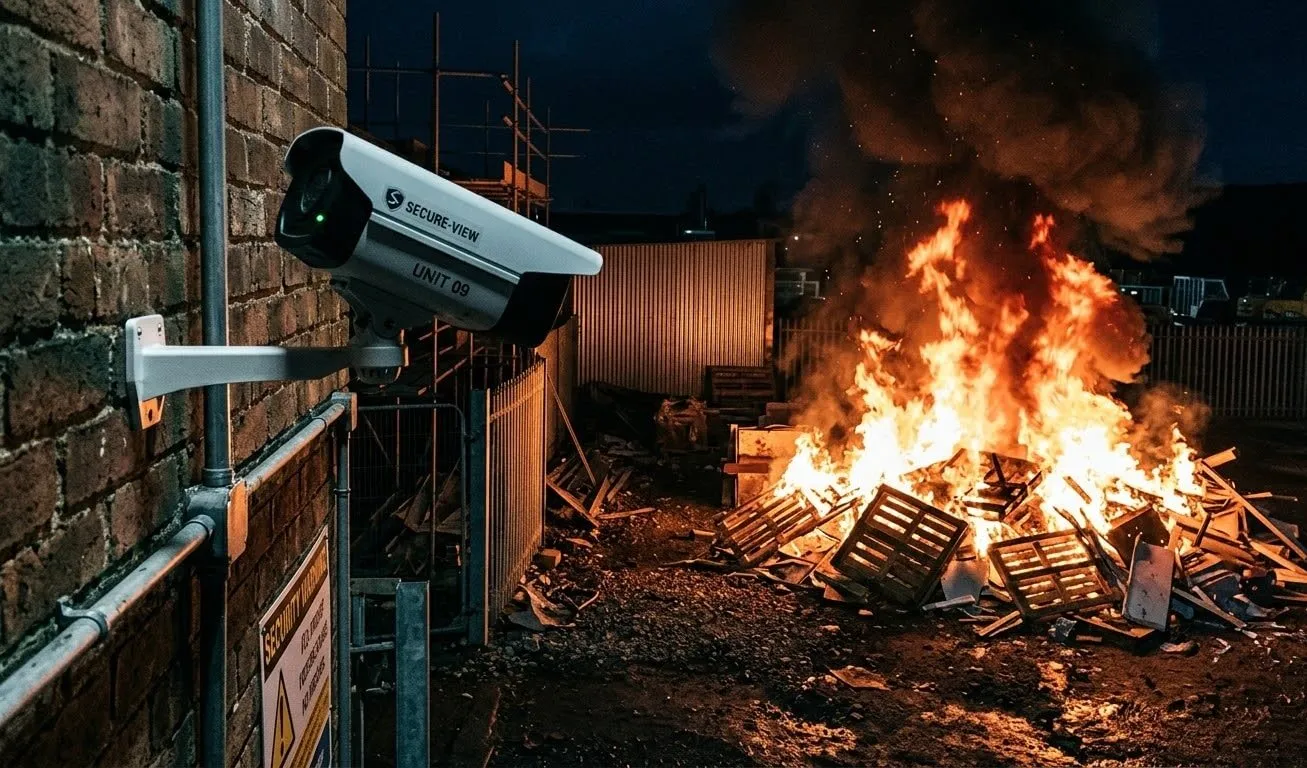
Traditional fire detection is reactive — it waits for smoke or heat to reach a sensor. Modern Video Flame Detection systems like the Ciqurix CORE are different: they watch for fire, triggering an alarm within seconds of ignition. Here's what every fire safety professional should know.
How It Works
The "Multi-Spectral" Approach Explained
Standard CCTV cameras can be fooled — sunlight, car headlights, and reflections can all trigger false alarms. Professional VFD systems solve this with a dual-lens design that combines two different technologies to make a confident, reliable decision.
Infrared (IR) Lens
Filters out the visible world entirely and looks for the invisible "blackbody" thermal radiation that flames always emit. This means it can detect fires even through smoke or partial obstructions.
Visual Lens
Captures a high-definition video feed. An onboard processor constantly analyses this feed for the colour signatures, flicker patterns, and movement behaviour that are unique to a real fire.
Analytic Fusion — The "Brain"
It is a common misconception to label these systems as "AI." In reality, the Ciqurix CORE uses Sophisticated Rule-Based Algorithms specifically designed for life safety. Unlike standard "AI" which can be unpredictable, these algorithms are deterministic. They analyse the visual and infrared feeds for specific physical signatures—flicker, brightness, and "blackbody" radiation—to make a definitive decision. This "Edge Processing" happens entirely inside the camera, ensuring the detection speed is never compromised by internet lag or external server issues.
Detection speed
10 Sec
False alarm rate
0.1%
Independent sensors
2
Battery backup
24 Hrs
Ciqurix Flame Detector: Detects Fires at 180m in Under 10 Seconds | BS 5839 Compliant Solution
Technology & The Future
Systems like the Ciqurix CORE run all their processing inside the camera itself, not on a remote cloud server. This approach is critical — it means detection speed is never slowed down by internet lag or server outages. The camera thinks for itself.
Looking ahead, expect to see deeper integration of Machine Learning (ML) neural networks — systems trained on thousands of hours of real-world footage. These will be able to distinguish between a harmless spark from an angle grinder and a genuine fire, or recognise the slow, "lazy" movement of smoke building up in a large warehouse.
Design & Installation
Under BS 5839-1:2025 — the UK's current Code of Practice for fire detection systems — "competence" is strictly defined. A standard CCTV engineer is not qualified to install these systems. They must be a trained fire safety professional.
Accredited Firms: Look for companies certified under BAFE SP203-1 or LPCB LPS 1014. These schemes confirm the installer has the technical knowledge to design, install, and commission a compliant fire detection system.
Manufacturer Training: VFD installation requires precise field-of-view (FOV) calculations and detailed lighting assessments. A competent installer should hold a current manufacturer training certificate — for example, a Ciqurix-approved installer qualification.
The Designer's Responsibility: The system designer must guarantee every camera has a clear, unobscured line of sight. If a new pallet rack or piece of machinery blocks a camera's view after installation, the system's compliance is immediately voided.
Certification
This is a common question. The short answer: when installed correctly, it is fully compliant — not a variation. Here's why:
LPS 1976 Certification: This is the key "Loss Prevention Standard." A Ciqurix CORE certified to LPS 1976 is recognised as a primary fire detection component — the same status as a standard smoke detector. Primary System Status: Unlike supplementary CCTV analytics (which are "nice to have"), an LPS 1976-certified system is tested to the same rigorous standards as EN 54 smoke detectors. Full BS 5839-1 Compliance: Because the system uses fire-rated cabling and includes its own 24-hour battery backup, it operates as a standard fire system component — making it a compliant solution, not a workaround.
💡 What is a "variation"? A variation is only required when you intentionally break a rule — such as omitting detection coverage from a specific room. Using an LPCB-approved technology to provide coverage is simply good design practice, not a deviation.
Acknowledgements
Special thanks to Steve Wesley (Head of Sales at Ciqurix Ltd) and Alan Chatterton (DVS) for their expert insights and technical support in the development of this article.
Under BS 5839-1:2025, installing VFD systems requires more than just technical skill—it requires a certified fire safety background. Get the credentials that prove your professional standing, from EAL Level 3 Awards to the BPEC FESS Experienced Worker Assessment.