Success message
Error message

In the complex ecosystem of building safety, fire doors are often overlooked. To the untrained eye, they are merely heavy doors; however, in the event of a fire, they serve as a critical life-safety component, designed to compartmentalise smoke and flames. When a fire door fails, the integrity of the entire building’s fire strategy is compromised.
For facilities managers and compliance officers, understanding the nuances of fire door maintenance is not just a best practice—it is a legal imperative.
Even a door that looks sturdy can be functionally useless in an emergency. The most common reasons for inspection failure include:
Damaged Intumescent Seals: These seals expand when heated to block smoke. If they are painted over, missing, or damaged, the door cannot do its job.
Excessive Gaps: If the gap between the door leaf and the frame is greater than 4mm (or as specified by the manufacturer), smoke will bypass the door long before the heat activates the seals.
Inadequate Self-Closing Devices: A fire door is only effective if it is closed. Faulty closers or doors that "bind" on the floor are frequent points of failure.
Compliance often falls at the first hurdle: installation. We frequently see:
Non-Compatible Hardware: Using standard hinges instead of fire-rated, CE/UKCA-marked alternatives.
Poor Frame Bedding: Leaving voids between the door frame and the wall, allowing fire to "wrap around" the installation.
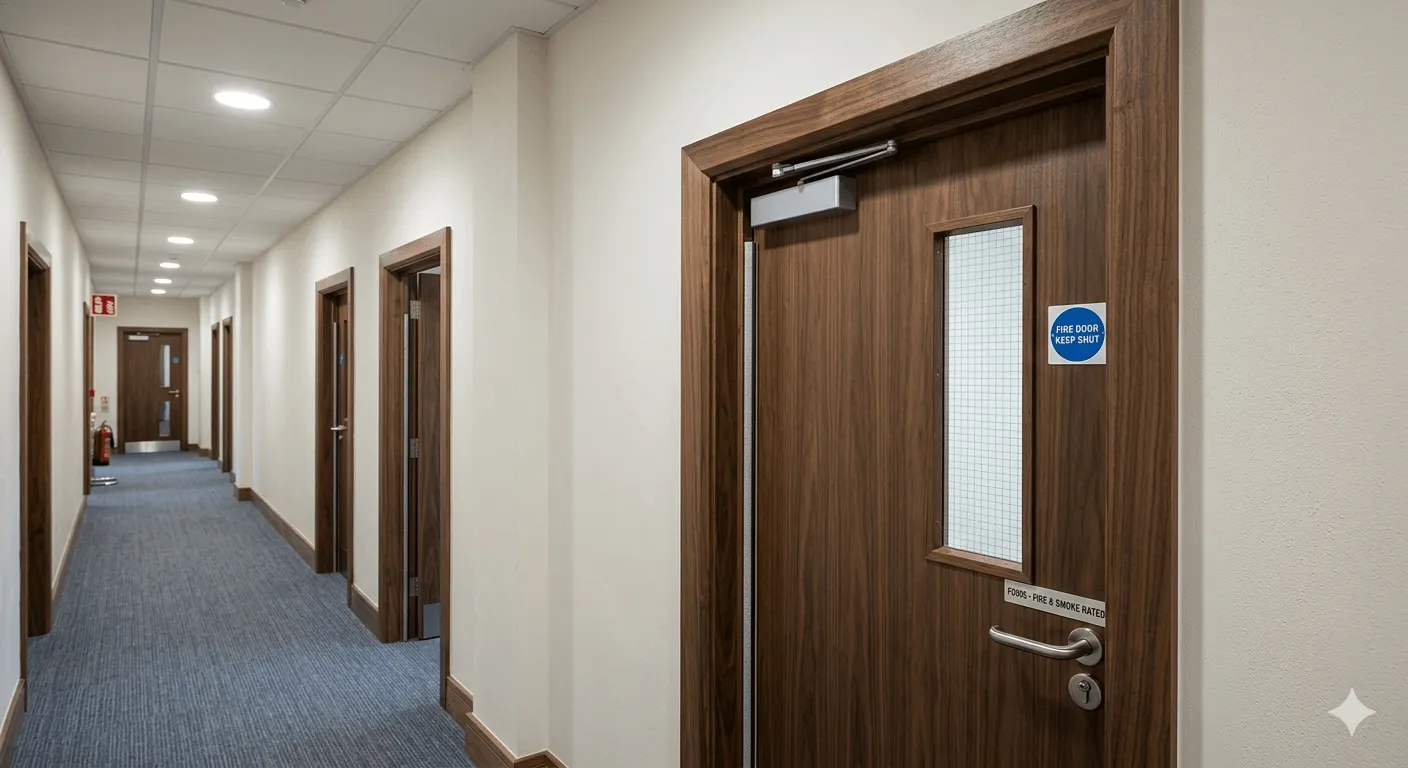
Incorrect Signage: Missing "Fire Door Keep Shut" or "Fire Door Keep Locked" notices, which are essential for occupant compliance.
Under the Regulatory Reform (Fire Safety) Order 2005 and the more recent Fire Safety (England) Regulations 2022, the "Responsible Person" has a clear legal duty. For buildings over 11 metres, there is now a mandatory requirement to conduct quarterly checks of all fire doors in common parts and annual checks of flat entrance doors.
Failure to comply can lead to unlimited fines, prosecution, or, in the worst-case scenario, the loss of life.
As regulations tighten, "visual checks" by untrained staff are no longer sufficient to mitigate risk. This is where professional competency becomes vital. A trained inspector understands the British Standards, knows how to identify non-compliant hardware, and can provide the documented evidence required by the local Fire and Rescue Service.
At LFS, we bridge the gap between "looking" and "inspecting." Our EAL Level 3 Award in Fire Door Inspection is specifically designed for facilities managers, compliance officers, and installers who want to formalise their expertise.
This qualification ensures you can:
Identify non-compliance with confidence.
Report accurately to meet legal audit requirements.
Protect your building’s occupants and your organisation’s reputation.
Don’t let a small detail become a major disaster. Ensure your team is competent, your doors are compliant, and your building is safe.